Find a View Worth Lingering Over
True perspective comes from staying long enough to watch cloud shadows glide across deep salt water, not from running up to three railing overlooks before noon.
A great fjord viewpoint is an encounter with deep geological scale. When standing atop a shelf like Stegastein, Dalsnibba, or Flydalsjuvet, the sheer drop can disorient your depth perception. Cruise vessels anchored on the surface resemble painted miniatures, and the roar of snowmelt falls sounds like gentle background static.
The Geometry of Fjord Overlooks
Unlike panoramic plains where the eye scans a broad horizontal line, fjord vistas operate vertically. You are visually coordinating three distinct zones:
- The Water Baseline: Mirrored reflections, passing ferry wakes, and sea grass margins at 0 metres above sea level.
- The Hanging Valley Shelf: Terraced meadows, abandoned summer pasture huts, and clinging pine groves between 200 and 500 metres.
- The Alpine Scarp: Bare gneiss cliffs, lingering snowfields, and cloud condensation lines above 800 metres.
Photographing Fjords Without Clichés
Most travel photographs of fjords look strangely flat because bright midday sun bounces off white haze, washing out stone textures. To capture the authentic mood of northern fjords:
Field Notes for Landscape Lenses
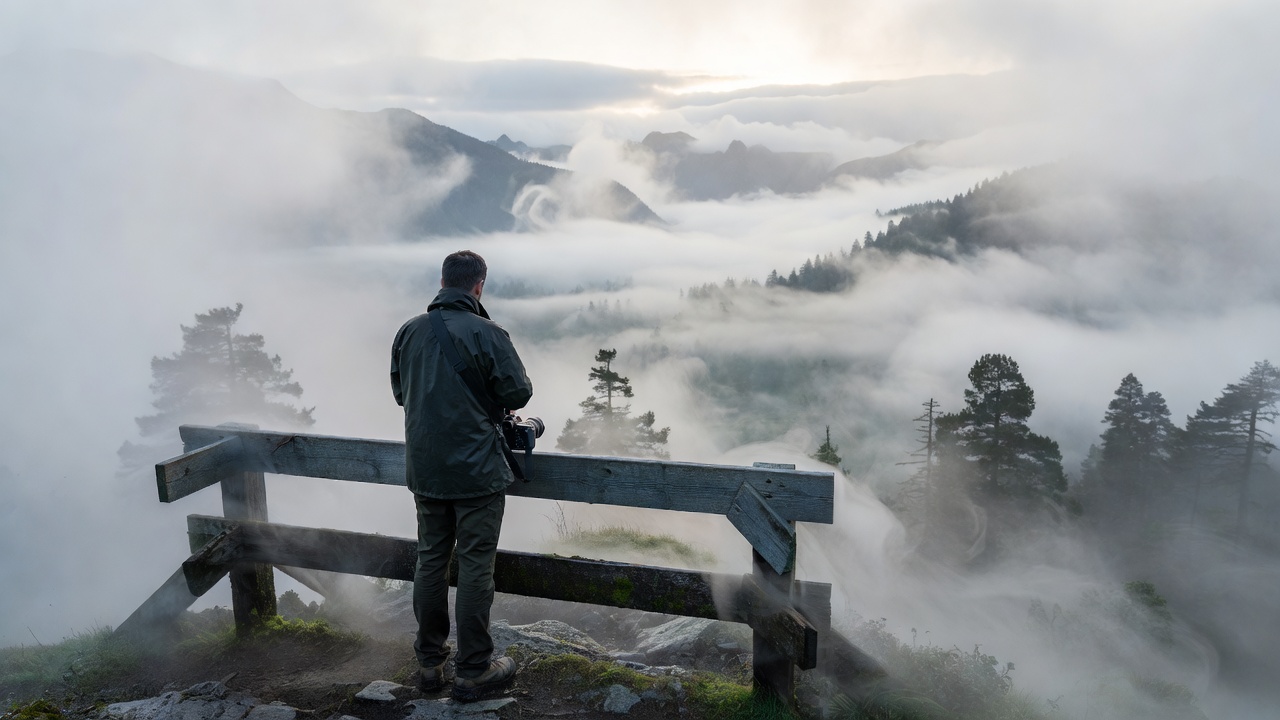
- Embrace mist and rain squalls: When low cloud caps the cliff edges, the atmospheric layering provides dramatic separation between foreground headlands and distant peaks.
- Use mid-telephoto focal lengths: While wide-angle lenses push mountain walls into the distance, a 70–135mm zoom compresses the dramatic scale, stacking fjord bends like cardboard cutouts.
- Watch the ferry wakes: A solitary car ferry leaving a sharp white furrow on dark teal water offers an immediate scale reference for the immense cliffs flanking it.
- Stay behind designated barriers: Never step over chain ropes or wooden fences onto mossy drop-offs. Subsurface turf often conceals air cavities undermined by winter frost.
Pacing Your Viewpoint Stops
Instead of driving the scenic bypass road to tick off four overlooks in an afternoon, select a single primary vantage point. Arrive thirty minutes before sunrise or settle in as the evening shadows fill the canyon floor. Bring a thermos, wind protection, and sit until the wind shifts.